Per-layer activation diffs against vLLM
Here’s a small tool Firefly that diffs a candidate ML model’s per-layer activations against a calibrated reference and tells you the first layer where they disagree. The intended use case is a CI gate: you point it at your model on every PR and it fails loud if the residual stream moves.
This post mainly discusses what happens when you run it against vLLM on some models.
The most useful finding, before any setup:
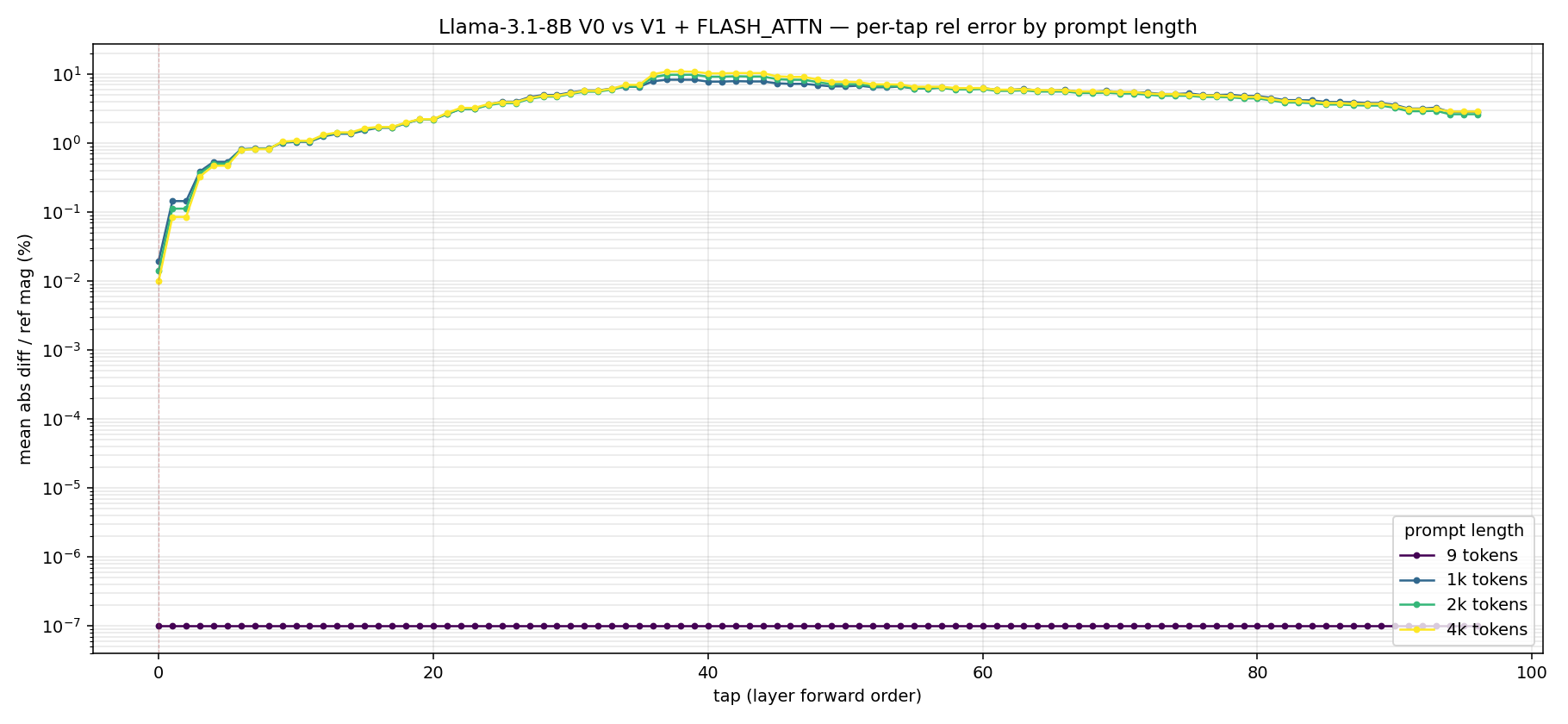
vLLM 0.8.5 V0 → V1 is bit-equal at 9-token prompts and diverges at every single layer past the first PagedAttention block boundary, with the exact same attention kernel on both sides. On Llama-3.1-8B, divergence saturates at ~2.8% final-layer relative error from 1k tokens through 4k tokens — it’s a step function, not a slope. A unit test that uses short prompts would pass this comparison. Production would silently change.
The rest of this post is how I got here.
(Related: the same per-layer machinery now drives the quantization loop — five measured ways a quantization number lies, the Gemma 4 day-one case study (the gate refused a 4× model, we retracted two catastrophic verdicts, and the corrected eval shipped it), and attribution-guided mixed-precision quantization.)
What’s Firefly
It’s a CLI plus a GitHub Action wrapper. The model is:
- Register forward hooks on every decoder layer’s
self_attn,mlp, and residual-stream outputs (plusfinal_norm). For a 30-layer model that’s 91 “tap points.” - Run the model on a fixed batch of golden inputs and stash each tap’s
output tensor to disk in a
weights.safetensors+manifest.jsonreference dir. That’s the reference. - To check a candidate, run the candidate against the same inputs, diff
per-tap, and walk the results in forward order to attribute the
first tap where the diff exceeds a calibrated tolerance. That’s the
“first divergence” — actionable in a way
eval_score = 0.87 → 0.83isn’t.
The architecture is intentionally boring. The capture, diff, and attribution modules are pure functions; the orchestrators wrap them with the model-loading and file-I/O. There’s no fully fledged online inference layer (yet), no hosted dashboard (yet), no novel ML (yet). The interesting part is the picks:
- Hook at the module boundary, not inside. vLLM and HF transformers
both expose
model.layers[i].self_attnas a top-level submodule. Even though their internals differ (vLLM fuses QKV into one Linear, HF keeps them separate), the module-level output is a tensor of the same shape. We tap there. - Calibrate the noise floor empirically. Every tap gets its own tolerance derived from re-running the reference 8 times. Flat thresholds are wrong in both directions — too tight on noisy taps, too loose on quiet ones.
- One forward-ordered list drives everything. The tap selector
returns layer 0’s
self_attn, thenmlp, then layer 0 residual, then layer 1’sself_attn, … etc. The capture loop, the diff loop, and the first-divergence walk all iterate this same list. “First divergence” semantics fall out for free.
The setup I tested against
Everything below is SmolLM-135M in BF16 on an NVIDIA A10G, prompt =
"the quick brown fox jumps over the lazy dog" unless noted. Captures
ran on Modal. vLLM 0.8.5 with enforce_eager=True (to keep forward
hooks working; CUDA graphs would skip them).
The reason for enforce_eager=True deserves a flag: in eager mode, hooks
work because every forward op is dispatched through the Python
interpreter. With CUDA graphs enabled — which is what production vLLM
actually runs — hooks would force graph breaks. So the measurements in
this post are a CI-time diagnostic: Firefly spins up its own
eager-mode vLLM, captures, and tears it down. That’s fine for a
per-PR check, where nobody’s watching the latency.
Capturing against live production traffic is a different constraint —
you can’t ask a serving stack to drop CUDA graphs and torch.compile.
That path needs a custom op that Dynamo treats as opaque
(tensor-in/tensor-out) so it survives compilation, plus something that
survives CUDA-graph replay, where there’s no Python callback to hang a
hook on at all. Both of those exist in a separate shadow-mechanism
branch (firefly.shadow): torch.ops.firefly.capture for the
eager/torch.compile path, and a Triton-kernel custom op
(capture_static) that writes stats into a pre-allocated GPU buffer
whose pointers get captured into the graph and re-run on every replay.
They’re validated by spikes and a Modal integration test, but the shadow
mechanism has never been run against a live production model — that
online plumbing is the part that isn’t built. (Offline capture from a
serving engine is wired and used heavily below: firefly check --runner
{vllm,sglang}. The unbuilt part is shadowing a model that’s serving real
traffic.) The findings below all use the eager-mode hook path.
The matrix
I ran 7 paired comparisons across the standard vLLM knobs — version, engine, attention backend, prompt length, decode mode, batch size. The short summary:
| Comparison | Result |
|---|---|
| 0.7.3 V0 vs 0.8.5 V0, auto backend | bit-equal |
| 0.8.5 V0 vs V1, auto backend | bit-equal |
| 0.8.5 V0 vs V1, FLASH_ATTN | bit-equal |
| 0.8.5 V0, FLASH_ATTN vs XFORMERS | diverges, first at layer.7.self_attn |
| Multi-request, V0 vs V1 (2 prompts) | shape mismatch (V0 packs, V1 doesn’t) |
| V0 vs V1, FLASH_ATTN, 300 tokens | diverges at every tap, first at layer.0.self_attn |
| FLASH_ATTN vs XFORMERS, 8 decode tokens | diverges everywhere, first at layer.0.self_attn@token_0 |
Three of these are real findings worth unpacking.
Finding 1: Different attention kernels → first divergence at layer.7.self_attn
Same model, same vLLM, same hardware, same prompt. Only difference:
VLLM_ATTENTION_BACKEND=FLASH_ATTN versus XFORMERS. Both are correct
implementations of scaled dot-product attention; they use different
reduction orders for the matmul.
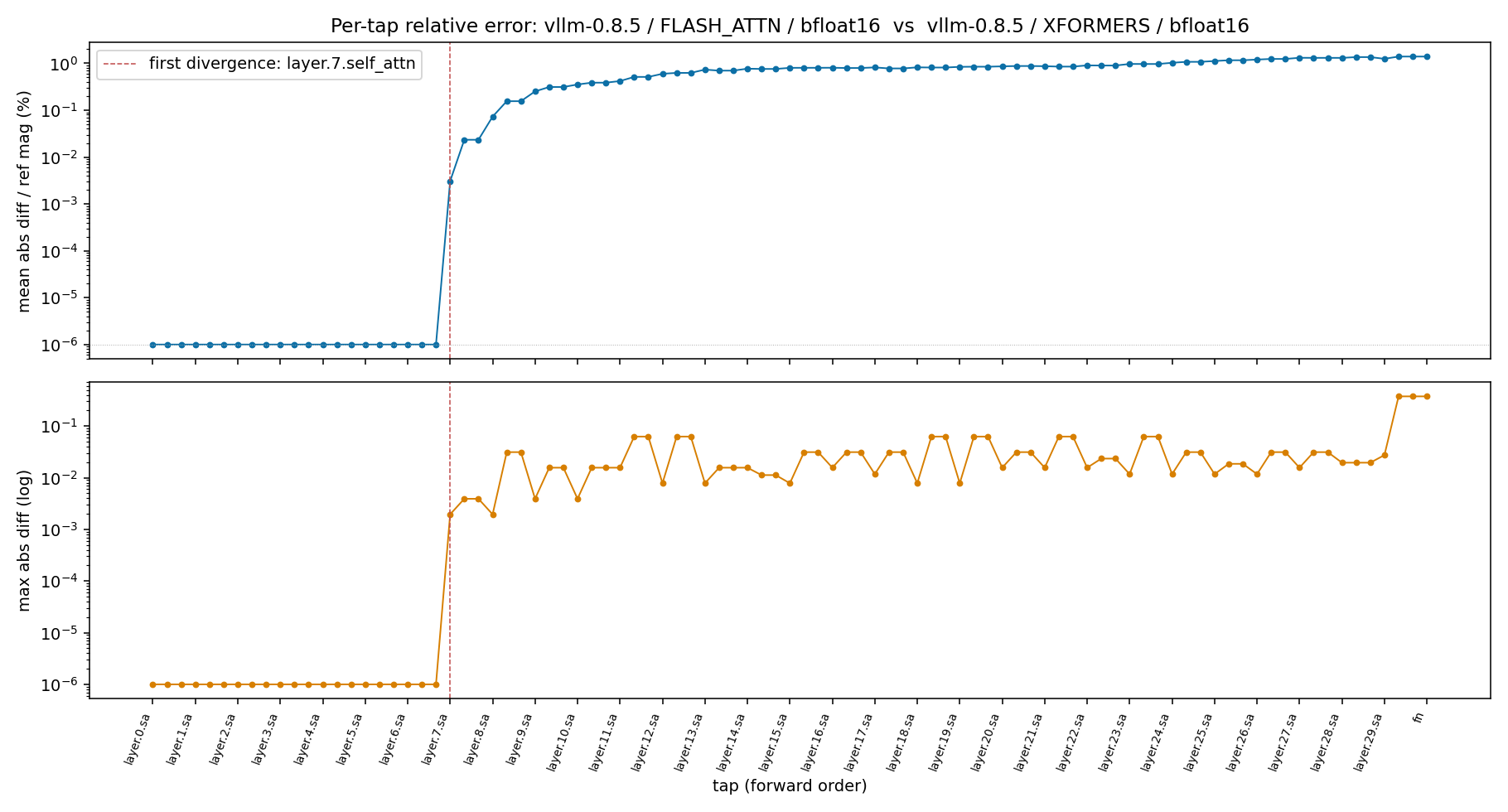
Layers 0–6 are bit-equal. Then at layer 7, the divergence cuts in
sharply — layer.7.self_attn is the first non-zero tap, and from there
relative error climbs through the residual stream to 1.4% by the final
LayerNorm. The shape of the curve is the textbook
“compounding-rounding-error” pattern in a deep network.
The interesting part isn’t that this happens — anyone who has worked on numerical kernels expects different reduction orders to round differently in low-precision. The interesting part is why divergence starts at layer 7 specifically, not layer 0.
Both backends produce different intermediate values starting at layer 0. But at low activation magnitudes (early layers), BF16’s 7-bit mantissa rounds those tiny differences to the same representable value. Around layer 7 of SmolLM-135M, residual-stream magnitudes have grown enough (this is the activation-magnitude phase transition Dettmers et al. documented in LLM.int8()) that the kernel-level differences cross the BF16 representable threshold.
So “first divergence at layer 7” is really “first layer where the kernel-rounding difference exceeds the precision representable threshold.” Firefly is correctly attributing to a coupling of three things — kernel difference × activation magnitude × precision-format floor.
I expected the boundary to move on a model with larger early-layer activations. The next section is the experiment I ran to test that prediction, and the result that made me rewrite this paragraph.
Finding 1.5: The layer-7 finding survives 60× model scale — and breaks at the family boundary
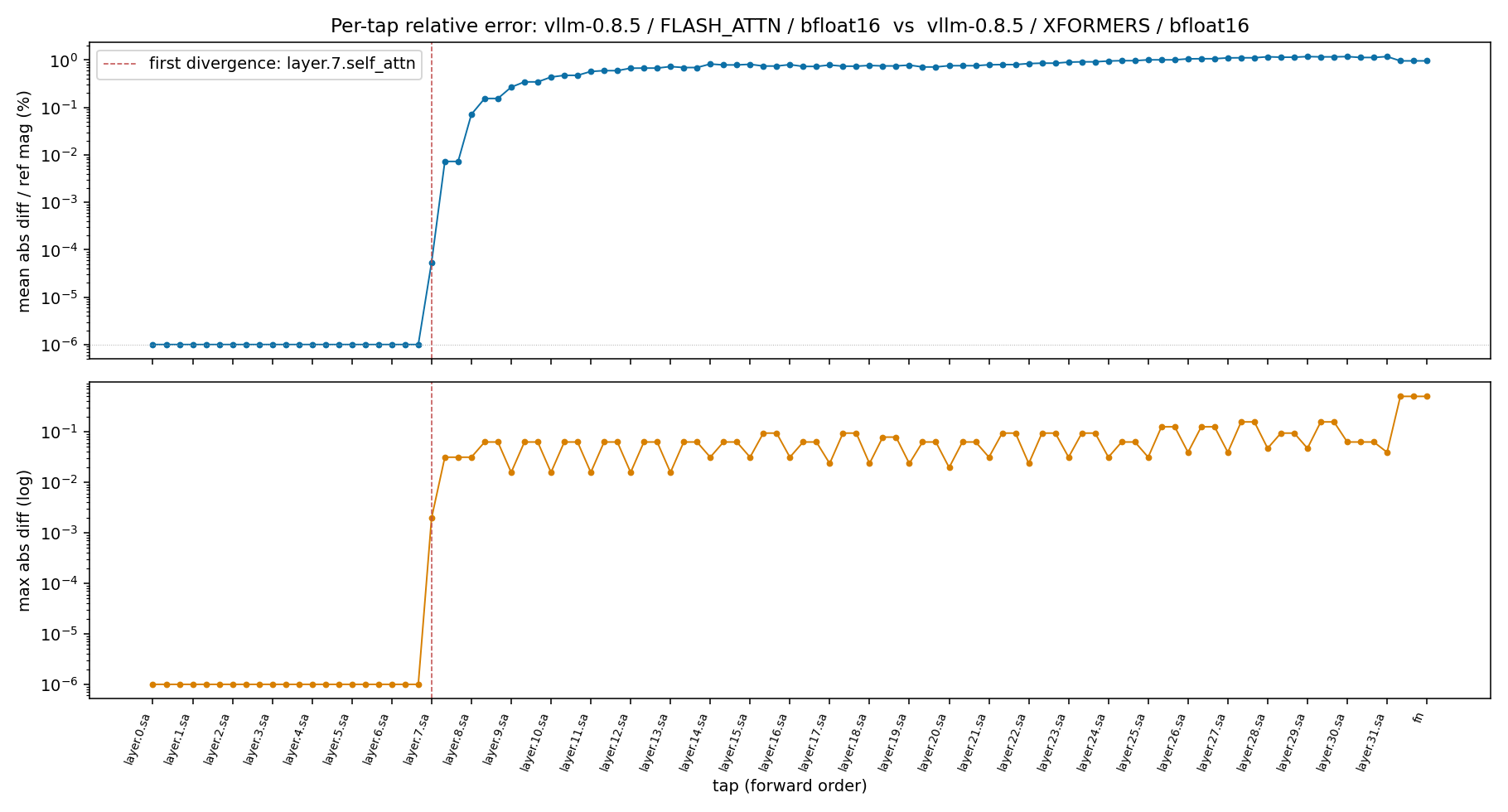
I expected the layer-7 boundary to shift on a much bigger model, so I ran two stress tests of Finding 1’s mechanism:
Within-family stress test (model scale). Same comparison, swap the
model from SmolLM-135M to meta-llama/Llama-3.1-8B on an A100-40GB —
same vLLM 0.8.5 V0, same BF16, same 10-token prompt. First divergence
held at layer.7.self_attn on a 60× larger model with a 7× wider
residual stream. Same layer index, similar fraction of taps
diverging, similar overall curve shape:
| SmolLM-135M | Llama-3.1-8B | |
|---|---|---|
| first divergent tap | layer.7.self_attn |
layer.7.self_attn |
| taps diverging | 70/91 (77%) | 76/97 (78%) |
| final-norm relative error | ~1.4% | ~0.96% |
| hidden dim | 576 | 4096 |
| layers | 30 | 32 |
I was about to declare the layer-7 boundary universal. But then the cross-family check broke it.
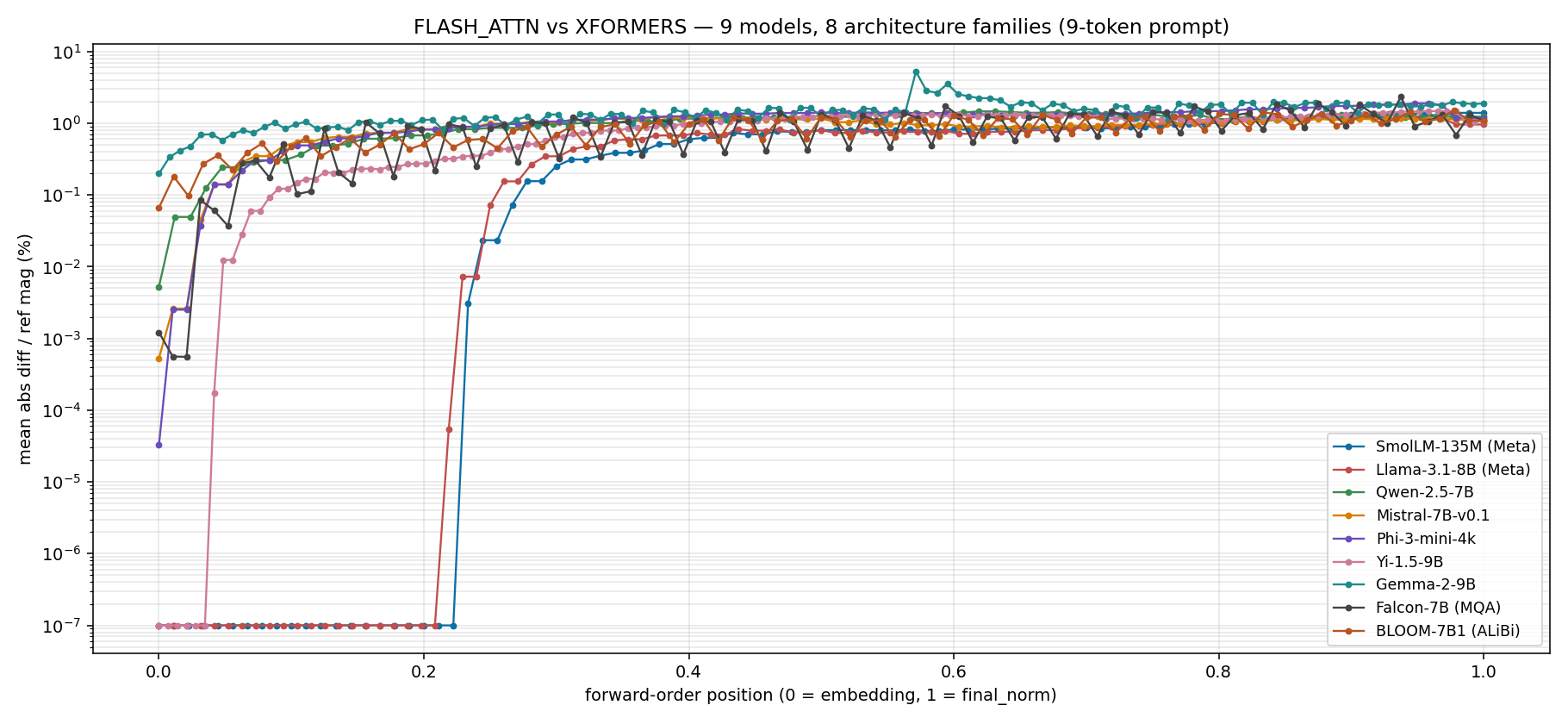
Cross-family stress test (7 more models, 7 more families). Same
comparison, swap the model again — to Qwen/Qwen2.5-7B,
mistralai/Mistral-7B-v0.1, microsoft/Phi-3-mini-4k-instruct,
01-ai/Yi-1.5-9B, google/gemma-2-9b, tiiuae/falcon-7b, and
bigscience/bloom-7b1. The last two test architectural axes none of
the earlier models had: Falcon uses multi-query attention (single
KV head shared across all query heads) and BLOOM uses ALiBi
positional encoding (per-position bias added to attention scores)
rather than RoPE:
| model | first divergent tap | layer-0 rel error | final-norm rel error |
|---|---|---|---|
| SmolLM-135M (Meta) | layer.7.self_attn |
~0% (bit-equal) | 1.4% |
| Llama-3.1-8B (Meta) | layer.7.self_attn |
~0% (bit-equal) | 0.96% |
| Qwen-2.5-7B | layer.0.self_attn |
0.0052% | 1.23% |
| Mistral-7B-v0.1 | layer.0.self_attn |
0.0005% | 1.12% |
| Phi-3-mini-4k | layer.0.self_attn |
≈0.00005% | 1.18% |
| Yi-1.5-9B | layer.2.self_attn |
~0% (bit-equal) | 1.06% |
| Gemma-2-9B | layer.0.self_attn |
0.1979% | 1.89% |
| Falcon-7B (MQA) | layer.0.self_attn |
0.0012% | 1.09% |
| BLOOM-7B1 (ALiBi) | layer.0.self_attn |
0.0663% | 1.08% |
Five things stand out:
- The layer-7 universality is real within the Meta architecture lineage (SmolLM, Llama-3) and breaks at every other family. Six of seven non-Meta models shift to layer 0 with FLASH vs XFORMERS.
- Yi-1.5-9B remains the lone outlier at layer 2 — neither 0 nor 7. With Falcon and BLOOM landing at layer 0 alongside Qwen / Mistral / Phi-3 / Gemma-2, the pattern isn’t even a clean “Meta-vs-not” dichotomy; it’s per-family.
- Architecture features that don’t matter for the
first-divergence layer: Falcon’s MQA (single KV head) and BLOOM’s
ALiBi (no RoPE at all) both land at the same
layer.0.self_attnas the GQA-with-RoPE non-Meta models. The earlier “vLLM XFORMERS dispatches differently per RoPE config” hypothesis is partially refuted by BLOOM — no RoPE, still layer 0. - Gemma-2’s layer-0 rel error is the largest by ~40× — 0.1979%
vs Qwen’s 0.0052%. Likely because Gemma-2 uses hybrid sliding-window
- full attention, so XFORMERS and FLASH_ATTN dispatch through very different code paths even at the first attention layer.
- Final-norm relative errors all fall in a 1.0%–1.9% band. Where the divergence starts varies by family, but the aggregate drift by the final layer-norm doesn’t.
The most likely driver of the family-level variation is a
vLLM-internal-dispatch effect. vLLM’s XFORMERS backend takes different
code paths depending on the model’s RoPE configuration — Llama-3.1
uses theta=500000 with rope_scaling; Qwen2.5 uses theta=1000000;
Mistral uses theta=10000; Yi-1.5 uses a different rope_scaling
factor. Different inverse-frequency tables get computed and reduced
differently, and BF16 rounding surfaces the difference at the first
attention layer rather than waiting for activation magnitudes to grow.
Corrected framing. Finding 1’s mechanism (kernel-diff × activation magnitude × precision threshold) is the right intuition. The original prediction “layer-7 will shift on larger models” was wrong about the scale dimension and right about there being some model-dependent dimension — I just had the wrong dimension in mind. The honest version of the universality claim:
- Within an architecture family (Meta-Llama lineage tested): first-divergence layer is universal across model scale. Two data points (SmolLM-135M, Llama-3.1-8B); the layer-7 boundary is stable.
- Across architecture families: first-divergence layer shifts, and the shift isn’t even uniform. Seven more data points (Qwen-2.5, Mistral-7B, Phi-3-mini, Yi-1.5-9B, Gemma-2-9B, Falcon-7B, BLOOM-7B1) — six land at layer 0, one (Yi) at layer 2. This holds for ALiBi (BLOOM, no RoPE) and MQA (Falcon, single KV head) as well as the more typical RoPE+GQA setups.
- The mechanism of “Firefly’s per-layer attribution points at the first BF16-visible difference” is unchanged. What that layer index is depends on the architecture-family-specific kernel dispatch.
That’s a less ambitious universality claim than I led with, but it’s the claim the data actually supports. Forward-pointer: Finding 4 will return to this with FLASHINFER, where the layer-0 finding turns out to hold across all eight supported models that can use FLASHINFER (one model can’t, for an architectural reason that’s its own finding) — different kernel pair, much more robust universality.
Finding 2: Decode capture exposes that layer 0 itself diverges
Same FLASH_ATTN vs XFORMERS comparison, but now I let the model generate
7 additional tokens after the prompt and captured activations at each
decode step. Tap names get suffixed: layer.7.self_attn@prefill for the
prompt forward, layer.7.self_attn@token_0..token_6 for each decode
step.
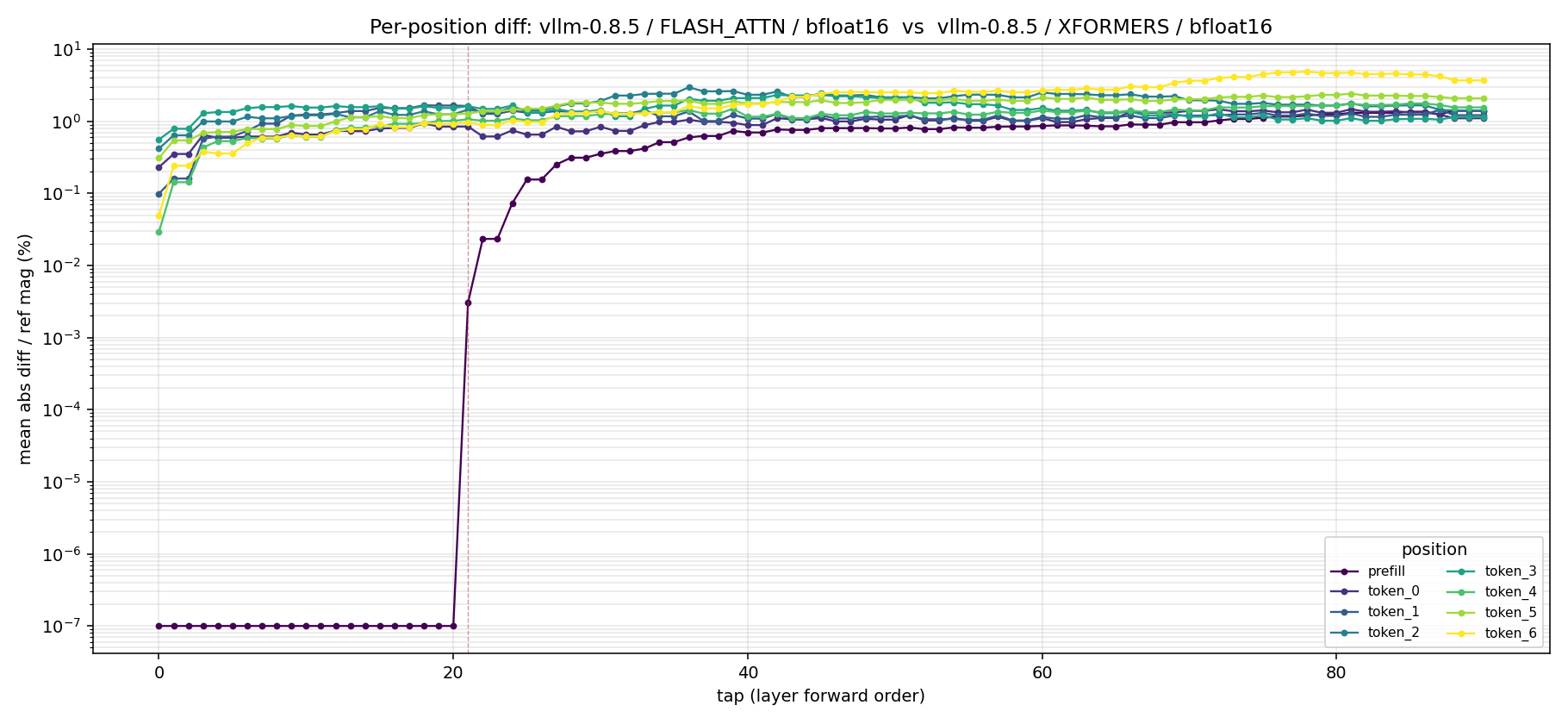
Three things happen at once in this plot:
-
Prefill (dark purple, bottom): the familiar layer-7 onset story. Layers 0–6 bit-equal, sharp jump at 7, climbs to ~1.4% by
final_norm. This is what we already had. -
token_0 (just above prefill): every layer now diverges, including
layer.0.self_attn. That’s the surprise — in prefill, layer 0 was bit-equal. I want to be careful about the mechanism here, because the obvious story (“the KV cache carries divergence into layer 0”) is wrong: each layer attends over its own KV cache, and layer 0’s prefill cache was bit-equal between the two backends. What actually changes at decode is the attention path — FlashAttention and xFormers both special-case single-query decode with a different kernel than prefill, so the rounding that stayed sub-threshold at layer 0 in prefill need not stay sub-threshold in the decode kernel. (A second possible contributor I haven’t isolated: under a 1.4%-divergent final logit, greedy decoding could pick a different token on one side, which would change layer 0’s input outright.) The honest, evidence-backed claim is the observation itself: there is no “layer 0 starts clean” regime once you’re decoding. -
token_1 through token_6 (stacked progressively higher): each successive curve sits above the last. This part is a cache- accumulation effect — but within a layer, not across layers: once a layer’s self-attn output diverges at a decode step, that position’s K/V at that same layer is now divergent, so later tokens attending over it read progressively more-divergent cached state. By token 6,
final_normis at 3.7% relative error, up from 1.4% at prefill.
In forward order with the unified tap naming (prefill first, then
token_0, token_1, … per tap), the first divergent tap is
layer.0.self_attn@token_0, not layer.7.self_attn as it is in
prefill-only mode. Decode is simply a harsher regime: the masking that
kept early layers bit-equal in prefill doesn’t hold once the decode
attention path is in play.
This shows that output-level monitoring is insufficient. The final-LayerNorm rescales by ~50× by the end of the network — output drift is small percent-of-scale. An eval that thresholds at 1% accuracy delta passes this comparison at token 0 and might keep passing for 50 tokens before the accumulated drift crosses the threshold.
Finding 3: The same engine swap that’s safe at 9 tokens is broken at 1k — and stays broken
This is the plot at the top of the post.
Same vLLM 0.8.5. Same FLASH_ATTN. Only difference: the V0 engine vs the V1 engine. I ran the comparison at four prompt lengths on Llama-3.1-8B (A100-40GB, BF16):
| prompt length | taps diverging | first divergence | final-norm rel error |
|---|---|---|---|
| 9 tokens | 0 / 97 (bit-equal) | — | 0% |
| 1k tokens | 97 / 97 | layer.0.self_attn |
2.84% |
| 2k tokens | 97 / 97 | layer.0.self_attn |
2.62% |
| 4k tokens | 97 / 97 | layer.0.self_attn |
2.86% |
I expected “monotonically growing with length.” That’s not what happens. The curve is a step function: bit-equal at very short prompts, immediately maxed-out divergence past the first PagedAttention block boundary, and roughly flat from 1k tokens onward. Length isn’t the threshold; block-count is.
Why? V0 uses flat attention — compute the full $QK^T \to \text{softmax} \to V$ product in one go. V1 uses PagedAttention, which is vLLM’s marquee feature: the KV cache is sharded into 16-token blocks, attention is computed block-by-block, and an online-softmax merge stitches the per-block scores back together. The math is equivalent. The reduction order is different. BF16 makes the difference visible.
At 9 tokens, only one block is involved. Single-block PagedAttention is arithmetically identical to flat attention — same reduction order, same bit pattern. At 1k tokens, 60+ block boundaries are crossed and the online-softmax merge has accumulated enough rounding error that every tap is past tolerance. Crossing from 1k to 4k adds more block boundaries but the per-element error from the merge is already saturated.
The implication is:
- Short-prompt unit tests pass. Anyone testing their vLLM upgrade with the typical 8-to-30-token prompts you find in test fixtures would see “V0 → V1 is bit-equal” and call the upgrade safe.
- Any realistic production prompt is in the divergent regime. 1k tokens is below most production prompt lengths. Whatever length you test at past the block boundary, you see the same ~2.8% final-norm drift.
- The kernel is literally identical. This is not a kernel-swap bug; it’s a blocking strategy bug. The argument “FLASH_ATTN on V0 and FLASH_ATTN on V1 are doing the same math” turns out to be true only at trivially-short context — below the block-boundary threshold.
A CI gate should catch this — quietly, automatically, before deploy. A short-prompt unit test would not. A benchmark eval might or might not, depending on how sensitive the eval metric is to ~3% absolute internal drift that final_norm rescales down.
Finding 4: FLASHINFER diverges at layer 0 — and its error grows with length
vLLM ships three attention backends — FLASH_ATTN, XFORMERS, and
FLASHINFER. FLASHINFER is the one production stacks at Together,
Fireworks, and DeepSeek actually use, because its split-K
parallelization beats FlashAttention 2 for single-query decode.
Getting it installed on Modal was tricky — flashinfer-python on
PyPI is a stub requiring a CUDA-specific wheel; attempts on
debian_slim failed with “CUDA_HOME not set”, on the
vllm/vllm-openai Docker image with a Python 3.12 aiohttp ABI
collision, and finally worked on a clean nvidia/cuda devel base
with explicit pip-install of vLLM and flashinfer.
Once it was working, the result:
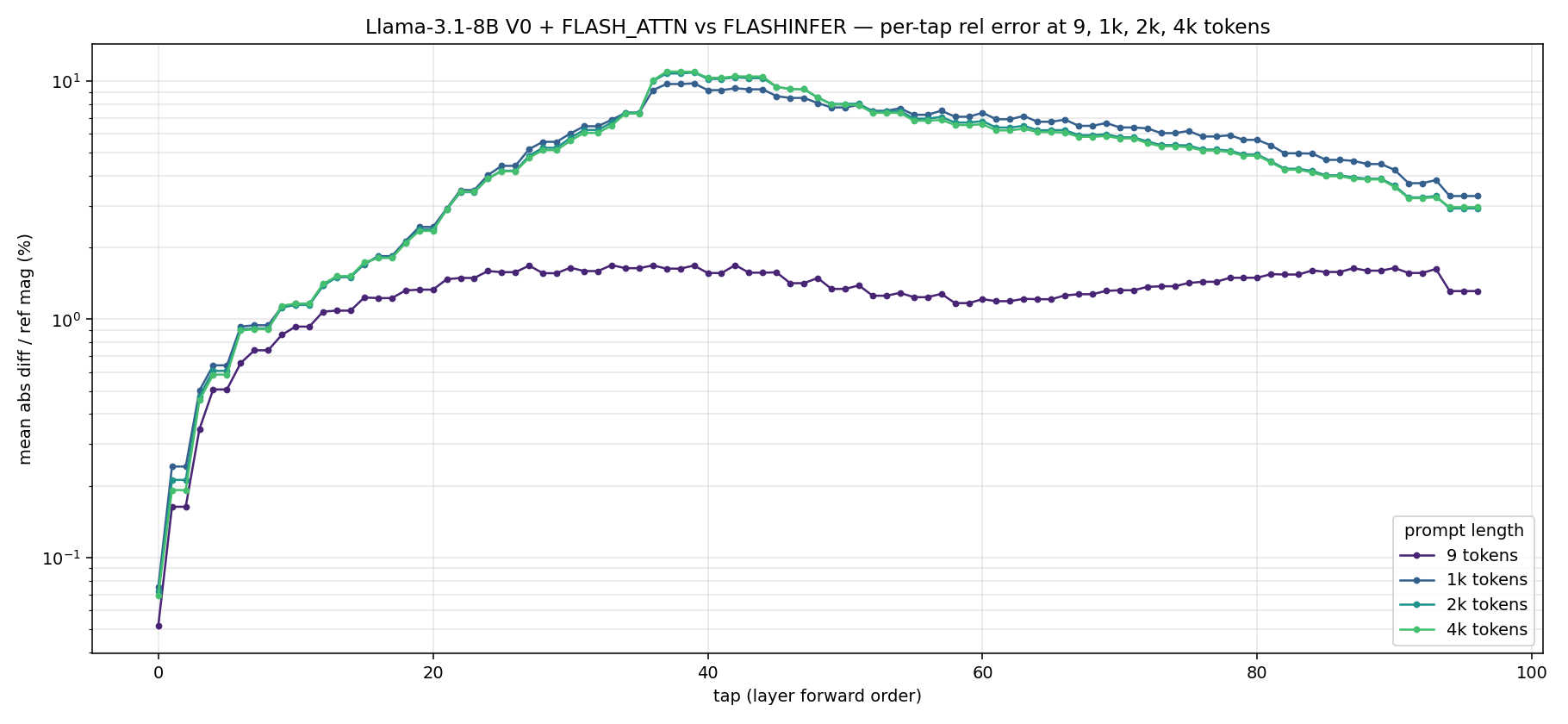
| length | first divergent tap | layer-0 rel | final-norm rel |
|---|---|---|---|
| 9 tokens | layer.0.self_attn |
0.0516% | 1.31% |
| 1k tokens | layer.0.self_attn |
0.0749% | 3.29% |
| 2k tokens | layer.0.self_attn |
0.0722% | 2.92% |
| 4k tokens | layer.0.self_attn |
0.0693% | 2.96% |
Two new things relative to the earlier findings:
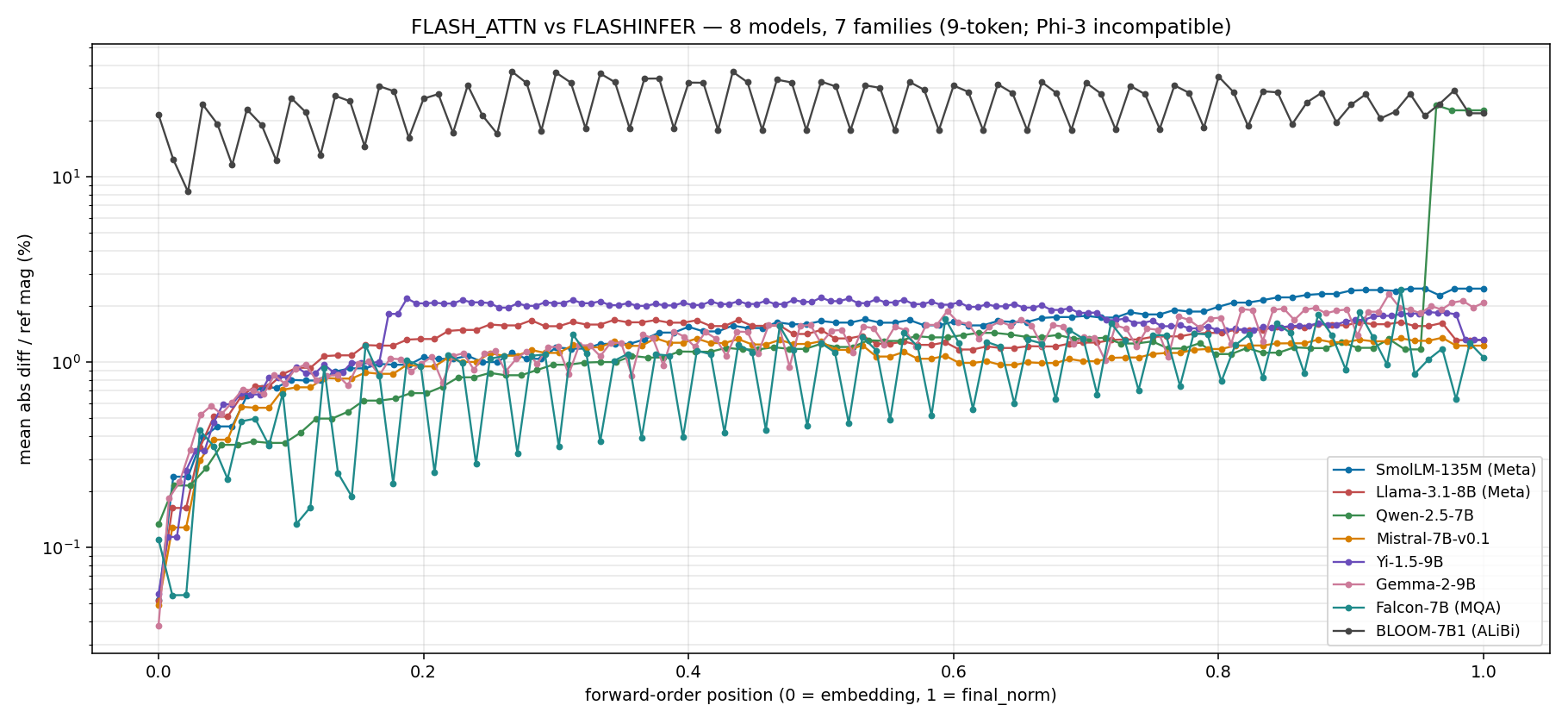
1. Layer 0, not layer 7 — and this one really is universal across families. The FLASHINFER vs FLASH_ATTN per-element kernel-difference is much larger than XFORMERS vs FLASH_ATTN’s: ~0.05% relative at layer 0 versus ~0.0001% at layer 0 for XFORMERS. The bigger per-element diff crosses BF16’s representable threshold immediately in early-layer activations. In contrast to the XFORMERS layer-7 finding that broke at the family boundary, the FLASHINFER layer-0 finding holds across all eight models I tested that can run FLASHINFER — covering Meta, Qwen, Mistral, 01.AI, Google, TII (Falcon, MQA), and BigScience (BLOOM, ALiBi) architecture lineages:
| model | first divergent tap | layer-0 rel | final-norm rel |
|---|---|---|---|
| SmolLM-135M (Meta) | layer.0.self_attn |
0.0519% | 2.49% |
| Llama-3.1-8B (Meta) | layer.0.self_attn |
0.0516% | 1.31% |
| Qwen-2.5-7B | layer.0.self_attn |
0.1332% | 22.83% |
| Mistral-7B-v0.1 | layer.0.self_attn |
0.0489% | 1.23% |
| Yi-1.5-9B | layer.0.self_attn |
0.0562% | 1.32% |
| Gemma-2-9B | layer.0.self_attn |
0.0380% | 2.09% |
| Falcon-7B (MQA) | layer.0.self_attn |
0.1104% | 1.06% |
| BLOOM-7B1 (ALiBi) | layer.0.self_attn |
21.59% | 22.00% |
So the kernel-pair-determines-the-divergence-layer story has some universal claims and some less-universal ones. FLASHINFER’s per-element diff is large enough to cross the BF16 threshold at layer 0 regardless of family-specific dispatch differences; XFORMERS’s smaller per-element diff is sensitive to those differences.
Two of the eight final-norm numbers are outliers: Qwen at 22.83% and BLOOM at 22.00%. They’re not the universal story, and they have mechanistically different failure modes — that’s Finding 5 below.
A separate FLASHINFER finding worth flagging. When I tried to run
the same comparison on Microsoft’s Phi-3-mini-4k-instruct, vLLM
init failed before any forward pass:
ValueError: Only [64, 128, 256] are supported for head_dim, received 96.
Phi-3-mini uses head_dim=96, which FLASHINFER’s kernels don’t
support. FLASHINFER isn’t a drop-in replacement for every supported
vLLM model, regardless of numerical drift. For a production stack
that needs to serve Phi-3-class architectures, this constraint is more
load-bearing than the layer-0 numerical drift finding.
2. The length curve is also a step-up-then-plateau, just at a higher plateau than V0 vs V1. I initially thought FLASHINFER’s length curve was monotonic (the original 9 → 1k jump was 2.5×, which read like growth in progress). Adding 2k and 4k tokens shows the plateau: 1k = 3.29%, 2k = 2.92%, 4k = 2.96%. The 1k number is even slightly higher than 2k and 4k — measurement noise within the saturated regime, not a trend.
So both length curves saturate past ~1k tokens — they just saturate at different heights:
| 9 tokens | 1k+ plateau | |
|---|---|---|
| V0 vs V1, same FLASH_ATTN | bit-equal | ~2.8% |
| FLASH_ATTN vs FLASHINFER | 1.31% | ~3.0% |
The explanation matches: FLASHINFER has two superimposed sources of difference:
- A constant kernel-level reduction-order diff (visible at 9 tokens, baseline ~1.3% final). V0 vs V1 doesn’t have this — same kernel.
- A length-dependent paging diff that compounds once you cross the first PagedAttention block boundary, then saturates because the per-block error doesn’t keep compounding to first order. This is the same mechanism V0 vs V1 has, at the same plateau height (~1.6-1.7% of additional final-norm rel).
Synthesis. Firefly’s per-layer attribution distinguishes three distinct failure modes that all look like “model output drifted” at the eval level:
| failure mode | example | first divergent tap | length curve |
|---|---|---|---|
| kernel reduction-order (small) | FLASH vs XFORMERS | layer.7.self_attn (Meta) / layer.0 or layer.2 (others) |
unknown |
| kernel reduction-order (large) | FLASH vs FLASHINFER | layer.0.self_attn |
step-up to ~3% then plateau |
| blocking strategy | V0 vs V1, same kernel | bit-equal short, layer.0.self_attn long |
step-up to ~2.8% then plateau |
Same attribution tool, three different signatures. Useful in production: an SRE seeing “Firefly says first divergence is layer.0.self_attn and the rel error grew between 1k and 4k” knows the kernel itself changed; “first divergence is layer.7” knows it’s a subtler kernel swap; “bit-equal at short and divergent at long” knows it’s a blocking-strategy change.
Finding 5: FLASHINFER has two catastrophic-divergence regimes — one Qwen-shaped and one BLOOM-shaped
The Qwen and BLOOM final-norm numbers from Finding 4 (22.83% and 22.00%) are both ~20× outliers vs the other six models. They look similar in magnitude. They are not the same mechanism.
The Qwen regime: late-layer outlier-feature spike
The Qwen 22.83% is not a distributed-everywhere-large-error situation. It’s a single-layer catastrophic spike. Through layers 0-26, Qwen FLASHINFER vs FLASH_ATTN tracks the other models — gradually climbing from ~0.13% at layer 0 to ~1.2% by layer 26, almost identical to Mistral’s curve. Then layer 27 happens:
| layer | Qwen rel error | Qwen mean(\|activation\|) |
|---|---|---|
| 26 | 1.17% | 0.526 |
| 27.self_attn | 24.31% | 0.989 |
| 27.mlp | 22.83% | 2.066 |
| final_norm | 22.83% | 2.066 |
A 20× jump in relative error in one layer. Qwen-2.5-7B has 28 layers (indexed 0-27), so layer 27 is its final transformer block. Mistral (32 layers, last index 31) has no analogous jump — its final layer sits at 1.35%. So this is not “last layer of anything” — it’s specifically Qwen.
Looking at the activation magnitudes plot for Qwen:
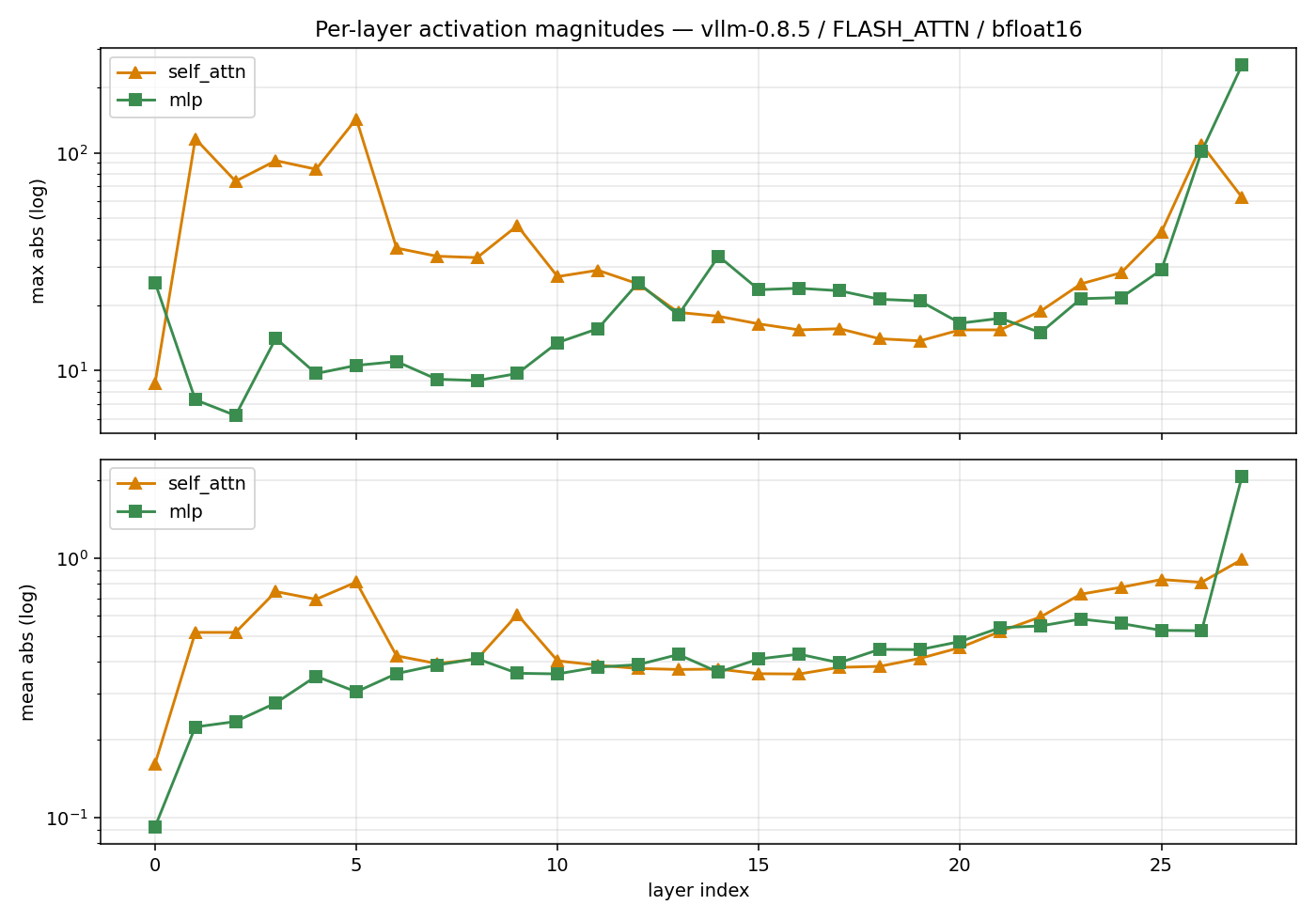
Qwen’s MLP outputs peak at a max(|activation|) of 252 — the
largest outlier-feature magnitudes in any model I tested (Llama tops
out at 40, SmolLM at 13). Crucially, the concentration is in the
late layers. Mistral has similar peak magnitudes (~176), but they
ramp up gradually across 32 layers; Qwen front-loads its outliers into
the final 1-2 layers.
The interaction is plausibly: FLASHINFER’s larger per-element reduction-order difference (visible from layer 0) compounds gradually through the network. At Qwen’s layer 27, where the activation magnitudes jump 4× from layer 26, the per-element diff suddenly has 4× more headroom to manifest in absolute terms — and the relative error spikes 20×.
Finding 6’s per-head instrument notes that the real mechanism is a discrete kernel behavior, not amplified rounding. The hypothesis-as-written is preserved here because the correction is the point; skip ahead to the end of Finding 6 for what’s actually happening.
This is the kind of finding a Qwen-on-FLASHINFER serving stack would
want to know about. The model’s output drift in BF16 with FLASHINFER
is a specific, localized, mechanistic issue concentrated in one layer
— not a broad model-wide degradation. An eval that looks at
final-output similarity would say “Qwen on FLASHINFER is meaningfully
different from Qwen on FLASH_ATTN” with no further attribution.
Firefly’s per-layer attribution localizes it to layer.27 and shows
its mechanism (magnitude × kernel-diff overshoot) in one plot.
Re-running the Qwen FLASHINFER capture from scratch produces bit-identical per-tap activations and the same 22.83% final-norm number to four decimal places — Firefly’s deterministic capture path makes the result a stable diagnostic, not a noisy measurement. And the catastrophic spike is Qwen-specific: Mistral-7B and Yi-1.5-9B both have similar peak activation magnitudes but no final-layer spike, because they spread their outlier features across more layers rather than concentrating them in the final 1-2.
I wasn’t certain it was a bug — it could have been the BF16-correct behavior given Qwen’s outlier-feature concentration at the final layer. However, the per-head result at the end of Finding 6 shows that exact-zero head outputs are not a rounding regime. Either way the diagnostic flow that surfaced it (swap one knob, run one Firefly check, look at the per-layer curve, then drill per-head) is what this tool is for.
The BLOOM regime: kernel-fundamental divergence from layer 0
BLOOM’s 22.00% looks superficially similar to Qwen’s 22.83% — both
are ~20× outliers, both surface with FLASHINFER. But the per-tap
curve tells a different story: BLOOM hits its catastrophic regime
immediately at layer 0 (layer.0.self_attn is already at 21.59%
rel error), and the curve stays flat at ~22% across every layer
through final_norm. There’s no gradual climb, no late-layer spike,
no per-layer mechanism to point at. The kernel is just wrong from
the first attention call.
The plausible explanation: BLOOM uses ALiBi positional encoding — attention scores get a position-dependent bias added in instead of having Q/K rotated by RoPE. FLASHINFER’s attention kernels are optimized around RoPE-first models; if its ALiBi path isn’t hand-tuned (or falls back to a generic implementation) and accumulates the bias in a different precision than FLASH_ATTN does, the per-element difference is large enough that even a single-token prompt produces a 22% relative error at the first attention.
The takeaway for the diagnostic story: Firefly’s per-layer attribution also distinguishes the two catastrophic regimes from each other, even though they show up at the same final-norm aggregate magnitude. A production observability dashboard that gates on output similarity would lump the two together; per-layer attribution shows that one is a localized late-layer issue solvable by skipping FLASHINFER on Qwen-specifically, and the other is a kernel-wide ALiBi-vs-FLASH_ATTN mismatch that affects every BLOOM-class deployment uniformly.
For a production stack picking attention backends, the practical implication is “FLASHINFER is not a drop-in for ALiBi-positional models in BF16.” It’s an architectural mismatch, not a per-model quirk.
Finding 6: The kernel divergence starts at exactly one attention head — at any model scale
Everything above attributes divergence to a layer. This pass drills
one level deeper: which attention head inside layer.7.self_attn
actually diverges first?
The mechanics first, because they constrain where you can look. You
can’t recover per-head outputs from the attention block’s output: the
output projection (o_proj) is a dense matmul that linearly mixes all
heads together. The only place per-head structure still exists is the
input to o_proj — the concatenated per-head context vectors. So
Firefly’s --per-head mode taps there, splits the tensor into
(n_heads, head_dim), and reports per-head max-diffs plus a
concentration ratio: worst head’s diff over the median head’s diff.
A high ratio means the divergence is localized to one head; ~1× means
it’s everywhere.
Running FLASH_ATTN vs XFORMERS again with per-head taps:
| bit-clean prefix | at layer 7 | heads diverging at layer 7 | |
|---|---|---|---|
| SmolLM-135M (9 heads) | layers 0–6 | head 2, max|Δ| 1.95e-03 | exactly 1 of 9 |
| Llama-3.1-8B (32 heads) | layers 0–6 | head 30, max|Δ| 6.10e-05 | exactly 1 of 32 |
That’s not “head 2 is the worst” — it’s every other head at layer 7 is bit-identical between the two kernels. One head cracks. By layer 8 the divergence has entered the residual stream and smeared across all heads (concentration drops to single digits), which is why layer-level attribution sees a clean break at layer 7 but per-head attribution is needed to see how surgical the break actually is.
The cross-scale replication is unexpected. Finding 1.5 established that the layer-7 layer boundary survives 60× model scale within the Meta lineage. The per-head data says the single-head-crack pattern survives too: on Llama-3.1-8B the first divergence is a few elements of one head out of 32 (mean |Δ| at that tap: 1.5e-09 — the max is 6.1e-05 concentrated in a couple of positions). The head index is not conserved (2/9 vs 30/32), which fits the Finding 1 mechanism: whichever head carries the largest activation magnitudes at layer 7 crosses the BF16 representability threshold first, and which head that is depends on where the model happened to put its outlier features.
And the FLASHINFER contrast makes the signature diagnostic. Running FLASH_ATTN vs FLASHINFER per-head (both captured on the same FLASHINFER-capable image, so the only variable is the backend): every head diverges from layer 0. Worst head at layer 0 is 9.8e-04, the median head is 1.2e-04 — nonzero everywhere — and the concentration ratio never exceeds ~9× anywhere in the network. No bit-clean prefix, no single cracking head.
So the two divergence classes from Finding 4 now have distinct per-head signatures:
| comparison | layer signature | per-head signature |
|---|---|---|
| FLASH vs XFORMERS | bit-equal until layer 7 | one head cracks (∞ concentration), then smears to single digits |
| FLASH vs FLASHINFER | diverges at layer 0 | all heads at once, uniformly (~1–9× everywhere) |
A debugging workflow can read this directly: high per-head concentration at the first divergent layer means “a specific head’s numerics crossed a precision threshold” (think: outlier features, magnitude-dependent rounding); flat concentration from layer 0 means “the kernel itself computes differently for everything” (think: different reduction order, different bias handling). Same tool, one extra flag, and the diagnosis gets a mechanism attached.
The Qwen payoff: the layer-27 spike is two silently zeroed heads
Then I pointed the per-head instrument at Finding 5’s open question — the Qwen-2.5-7B + FLASHINFER 20× spike at layer 27 — expecting to see the outlier-feature head with elevated-but-continuous divergence, which would have confirmed the “magnitude × kernel rounding” hypothesis.
That’s not what the data says. Layers 0–26 show FLASHINFER’s usual uniform kernel signature (concentration 1.5–7.5×). At layer 27:
| layer.27 head | max|Δ| | head’s own max|activation| (FLASH) | rel |
|---|---|---|---|
| 10 | 68.5 | 68.5 | 100% |
| 13 | 68.5 | 68.5 | 100% |
| 7 | 0.14 | 68.5 | 0.21% |
| 26 | 0.13 | 8.9 | 1.41% |
| (other 24 heads) | ≤0.094 | — | ≤3.9% |
Two heads at exactly 100% relative error, 26 heads at ordinary kernel noise. And 100% isn’t “very divergent” — checking the raw tensors: FLASHINFER outputs all-zeros for heads 10 and 13 of layer 27. Every token, every dimension, exactly 0.0. FLASH_ATTN produces real values there (peaking at 68.5 — the largest activation anywhere in the model, at the BOS token). Scanning all 784 (layer, head) pairs in the network: these two are the only zeroed outputs, on either backend.
A softmax-weighted average of value vectors can’t be exactly zero by accident. This is a discrete kernel behavior — FLASHINFER’s path is dropping those two heads’ outputs entirely — and o_proj then mixes the missing contribution into every output channel, which is why the layer-level view in Finding 5 showed a diffuse-looking 24% error instead of two missing heads.
The structure around it is suggestive. Qwen-2.5-7B is GQA with 4 KV heads (7 query heads per group). Heads 7–13 — the group sharing KV head 1 — are exactly the heads whose outputs carry the model’s massive BOS-token activation (all seven peak at exactly 68.5, since they share the same V and all sink on BOS). FLASHINFER zeroes two of those seven. So the zeroing is co-located with the massive-activation attention-sink structure, but magnitude alone doesn’t determine it — heads 7, 8, and 11 see the same 68.5 and survive. The trigger inside the kernel is the remaining open question, and it’s now sharp enough to file upstream: which code path in FLASHINFER’s prefill kernel returns a zero output row for these two specific (query-head, KV-group-1) combinations on Qwen-2.5-7B at BF16?
It’s a live bug, not a historical one. I re-ran the pair on current vLLM (0.22.1, V1 engine, which pins flashinfer-python 0.6.11.post2 — roughly two years of FlashInfer releases past the 0.2.x that vLLM 0.8.5 used): heads 10 and 13 of layer 27 are still exactly zero, same two heads, FLASH_ATTN still fine. The repro now spans two completely different vLLM integration layers — the deleted V0 engine and the current V1 engine — which moves suspicion firmly toward FlashInfer’s own prefill path (or an invocation pattern both vLLM generations share) rather than vLLM glue code.
That re-run came with a methodological trap worth recording: modern
vLLM silently ignores the VLLM_ATTENTION_BACKEND environment
variable (backend selection moved to an attention_backend engine
argument). My first “repro attempt” on 0.22.1 produced two
bit-identical captures — both had quietly run the default backend,
and a naive reading would have concluded “fixed upstream.” The
capture harness now reads the attention implementation class off the
live model (FlashAttentionImpl vs FlashInferImpl) and refuses to
proceed when it doesn’t match the request. If your comparison tooling
trusts its own knobs, the knobs will eventually lie to you; verify
the thing you’re varying actually varied.
The hypothesis I wrote in Finding 5 was a smooth-numerics story, and the per-head instrument built to test it found a discrete bug-shaped behavior instead. That’s a reasonable argument for attribution tooling — each level of attribution (layer → head → tensor) didn’t just narrow the location, it changed the mechanism class of the explanation.
Finding 7: The reference artifact doubles as a quantization-risk map
This one isn’t a divergence finding — it’s a reuse of the data Firefly already has. A reference artifact contains every tap’s full activation tensor. That’s exactly the input you need to answer a different question: which layers will break if I quantize this model?
firefly quant-risk --reference <dir> simulates symmetric
round-to-nearest int8 (or int4) quantization of each stored activation
twice — once with a single per-tensor scale, once with one scale per
channel — and reports the relative error of each, per tap. No model
run, no quantized weights; it’s pure arithmetic on tensors you already
captured for parity checking.
One metric decision matters enough to flag: the error is computed within each channel and then averaged across channels, not as a single magnitude-weighted global mean. The failure mode this catches is the whole point: when one channel is 1000× the others, a per-tensor scale sized for the outlier rounds every normal channel to zero — 100% error on each of them — while a global error metric barely moves, because the outlier channel dominates its numerator and denominator alike. (My first implementation used the global metric; the unit test for “one outlier channel” showed per-channel scaling only winning 3.7×, which was the metric hiding the damage, not the damage being small.)
Running it on the SmolLM-135M FP32 reference from the earlier validation work:
| tap | max|activation| | channel concentration | int8 per-tensor err | int8 per-channel err | gain |
|---|---|---|---|---|---|
| layer.9.mlp | 35.5 | 9.1× | 7.7% | 0.8% | 9× |
| layer.10.mlp | 49.7 | 9.3× | 5.3% | 0.5% | 11× |
| layer.11.mlp | 30,300 | 768× | 98.0% | 1.2% | 81× |
| layer.12 (residual) | 31,900 | 939× | 99.0% | 0.7% | 142× |
| layer.13 (residual) | 32,000 | 943× | 99.0% | 0.7% | 146× |
This is the layer-11 outlier-feature phase transition from the
validation findings — the same max(|activation|) jump from ~50 to
~30,000 in one layer that made TF32 noise spike there — now read out
as a quantization-risk statement: per-tensor int8 at layer 11 puts
the average channel at 98% relative error — most channels round to
zero — and per-channel scaling recovers it to 1.2%. The residual
stream stays in that regime through layer 27, exactly where the
magnitudes stay locked at ~32k.
First, it’s a quantitative re-derivation of why LLM.int8(), SmoothQuant, and every production W8A8 scheme ended up outlier-aware — derived from one CLI command on an artifact that was captured for a completely different purpose. Second, it closes a loop within this post: Finding 1’s mechanism (kernel divergence surfaces where activation magnitudes cross the BF16 threshold) and Finding 7’s mechanism (quantization breaks where activation magnitudes are outlier-concentrated) are the same underlying object — the model’s activation-magnitude profile — read through two different failure modes. Capture it once, and both diagnostics are queries against it.
This simulates round-to-nearest quantization of
activations in isolation. A real quantized serving stack has fused
dequant epilogues, weight quantization, and calibration data that
shift the picture. quant-risk is a map of where to look, not a
substitute for evaluating the quantized model.
Takeaways
Tolerance calibration is environment-sensitive. Same-machine
calibration measures runs-on-this-machine variance; cross-machine FP
variation is a different (and often larger) noise distribution. A useful fix in the
product is a --jitter-floor that composes with the per-tap calibration —
it ignores relative drift below a set fraction of max|ref|, absorbing
cross-platform jitter (it can only loosen the gate, never tighten it). The
lesson: “calibrated tolerances” alone aren’t portable; they need an
environment-stationarity escape hatch. And calibration only earns its keep
under real nondeterminism — on bit-deterministic CPU+fp32 it collapses to the
flat defaults, so a CPU-gated CI leans on the --jitter-floor ceiling and a
GPU-derived tolerances.json, not on CPU calibration.
Per-layer attribution is important. “Your eval dropped 2 points”
is extremely difficult to debug.
“layer.7.self_attn is the first divergent tap” points directly at the
attention kernel. The cost of producing this attribution is N forward
hooks and a sort — trivially cheap. The cost of not producing it
shows up every time someone debugs a serving-stack regression.
Decode-step capture is required. Prefill-only is the easy case. Decode is where the production knobs (PagedAttention, scheduler, spec decode) actually live, and it’s where divergence compounds via KV cache. Prefill-only tools will miss most real upgrade-time bugs.
Limitations
- Nine models, eight architecture families. Meta lineage (SmolLM-135M, Llama-3.1-8B), Qwen-2.5-7B, Mistral-7B-v0.1, Phi-3-mini-4k, Yi-1.5-9B, Gemma-2-9B, Falcon-7B (MQA + RoPE), BLOOM-7B1 (MHA + ALiBi). The XFORMERS layer-7 pattern is within-Meta only; non-Meta is layer 0 on 6 of 7 with Yi as the outlier at layer 2 — regardless of MQA vs GQA or RoPE vs ALiBi. FLASHINFER’s layer-0 universality holds across all 8 models that can run FLASHINFER (Phi-3 hard-incompatible, head_dim=96; BLOOM runs but produces a 22% kernel-wide ALiBi mismatch).
- One precision format primarily. Most of my runs are BF16; the earlier validation work showed FP32 is bit-deterministic on the same setup, and FP16 behaves like BF16 from a reproducibility standpoint (different mantissa, same general pattern). Quantized regimes (INT8/INT4) would surface different failure modes — Finding 7 simulates activation quantization from stored tensors, but real quantized kernels (fused dequant, weight quant, calibration) are untested territory.
- One inference engine. Firefly currently has a vLLM-specific capture path. SGLang and TGI would each need their own. The engine- internal differences (apply_model vs collective_rpc, etc.) are the per-engine engineering cost.
- Live shadow capture is a built mechanism, not a proven product.
Every number in this post came from eager-mode CI capture (forward hooks
can’t survive CUDA graphs). The CUDA-graph-safe custom op for capturing
against live compiled traffic exists in the
shadow-mechanismbranch (firefly.shadow) and survives a synthetic compiled model, but two things are open: I haven’t measured its per-token overhead (the first question any latency-sensitive team asks), and I haven’t run it against a real serving deployment. It’s also structurally limited to models you instrument yourself — vLLM and SGLang compile their own model code, so you can’t inject the capture op into them. Honest status: a promising primitive, not a drop-in production monitor.
Reproduce
The full repo is at github.com/neelvad/firefly. To rerun the matrix locally:
git clone https://github.com/neelvad/firefly && cd firefly
uv sync --all-extras
uv run python scripts/run_vllm_suite.py
The reference dirs for the V0/V1/FLASH_ATTN/XFORMERS combinations
referenced here aren’t in the repo (they need a GPU to produce), but
scripts/capture_vllm.py is the script that produced each one and the
test suite YAML at scripts/vllm_test_suite.yml declares each
(reference_a, reference_b, expected) tuple so you can regenerate them.
The headline length-curve comparison is eight commands on Modal A100-40GB, ~$2–5 total. A single 9-token + 1k pair is enough to see the step-function behavior if you want to skip 2k / 4k:
# 9-token bit-equal baseline
uv run modal run scripts/capture_vllm.py \
  --vllm-tag 0.8.5 --engine v0 --attention-backend FLASH_ATTN \
  --model meta-llama/Llama-3.1-8B --gpu A100-40GB --gpu-memory-utilization 0.7 \
  --out llama_v0_flash_short

uv run modal run scripts/capture_vllm.py \
  --vllm-tag 0.8.5 --engine v1 --attention-backend FLASH_ATTN \
  --model meta-llama/Llama-3.1-8B --gpu A100-40GB --gpu-memory-utilization 0.7 \
  --out llama_v1_flash_short

# 1k-token divergent regime
uv run modal run scripts/capture_vllm.py \
  --vllm-tag 0.8.5 --engine v0 --attention-backend FLASH_ATTN \
  --model meta-llama/Llama-3.1-8B --gpu A100-40GB --gpu-memory-utilization 0.7 \
  --prompt-file scripts/prompts/long_1k.txt --max-seq-len 1100 \
  --out llama_v0_flash_long1k

uv run modal run scripts/capture_vllm.py \
  --vllm-tag 0.8.5 --engine v1 --attention-backend FLASH_ATTN \
  --model meta-llama/Llama-3.1-8B --gpu A100-40GB --gpu-memory-utilization 0.7 \
  --prompt-file scripts/prompts/long_1k.txt --max-seq-len 1100 \
  --out llama_v1_flash_long1k
uv run python scripts/plot_validation.py diff scripts/results/llama_v0_flash_long1k scripts/results/llama_v1_flash_long1k produces the per-tap curve at 1k tokens. The full overlay (9 / 1k / 2k / 4k on one chart) needs the 2k and 4k pairs as well; swap the prompt file and --max-seq-len accordingly.
The Finding 6 per-head comparison is two captures plus one local diff (SmolLM on A10G is ~$0.10; swap in the Llama model/GPU flags above for the 8B version):
uv run modal run scripts/capture_vllm.py \
  --vllm-tag 0.8.5 --attention-backend FLASH_ATTN --per-head --out flash_ph
uv run modal run scripts/capture_vllm.py \
  --vllm-tag 0.8.5 --attention-backend XFORMERS --per-head --out xformers_ph

uv run python scripts/compare_per_head.py \
  scripts/results/flash_ph scripts/results/xformers_ph
For the Qwen zero-head result, use --vllm-tag 0.8.5-fi --model
Qwen/Qwen2.5-7B --gpu A100-40GB --gpu-memory-utilization 0.7 with
backends FLASH_ATTN and FLASHINFER, then
experiments/analyze_qwen_layer27.py <flash_dir> <flashinfer_dir> prints
the per-head magnitude/divergence breakdown at layers 25–27.
Finding 7 needs no GPU at all — any captured reference works:
uv run firefly quant-risk --reference <reference-dir> --bits 8
What’s next
-
More cross-family models. Phi-3, Yi, and Gemma-2 added in this pass. The remaining gaps are non-GQA architectures (Falcon), non-Llama-style positional encodings (e.g., ALiBi), and very small non-Llama models (Pythia, etc.). Each new family is a cheap data point (~$1 of Modal time) once the model’s HF gate is accepted.
-
Does the Yi
layer.2first-divergence reproduce or shift on Yi-1.5-34B? Yi being the lone “layer 2” data point — neither the layer 0 of Qwen/Mistral/Phi-3 nor the layer 7 of Meta — is suspicious. Either Yi has a unique RoPE handling quirk that produces this exact onset, or the layer 2 number is a one-off that would shift on a larger Yi model.