Which layers should you keep in high precision?
Firefly started as a CI gate that diffs a model’s per-layer activations against a reference. The same machinery answers a question quantization people actually have: when int8/int4 hurts my model, which layers are responsible, and what do I keep in high precision to get the quality back?
torchao’s autoquant searches for a fast config that clears a tolerance, but
when it doesn’t, it can’t tell you why or what to try next. Firefly measures
the cause directly.
The mechanism
For each decoder layer, quantize only that layer (everything else stays fp) with real torchao kernels, and measure the resulting divergence at the model’s output. That ranks layers by how much their quantization hurts. Then build and verify a recipe: keep the top-k most-sensitive layers in high precision, quantize the rest, and measure how much of the degradation you actually recover.
Nothing here is predicted from a proxy — every number is a measured forward pass.
This is a feature-selection problem
Choosing which layers to keep in high precision is, structurally, subset selection: a set of “features” (layers), and you pick which to keep fp to minimize quality loss under a budget. (The general K-bit version is categorical per layer — a knapsack/bit-allocation problem — but the keep-fp-vs-quantize case is exactly binary subset selection.) That maps the methods people use onto the classic feature-selection taxonomy:
- Filter (cheap per-item score, then threshold) → per-layer sensitivity
ranking. Our
isolated/marginal; HAWQ’s Hessian-trace sensitivity; AWQ’s activation salience. - Wrapper (evaluate subsets by running the model) → search. Our
greedy(sequential forward selection); HAQ’s RL bit-allocation. - Embedded (learned during training) → learnable bit-widths (DNAS, QAT).
And the reason wrapper methods beat filter methods in feature selection — interactions / non-additivity — is exactly what shows up here.
Three strategies, measured head to head
How you choose the keep-set is a pluggable strategy:
- isolated (filter) — quantize only layer
i; rank by the divergence it causes alone. Surfaces the intrinsically hard-to-quantize layers. - marginal (filter) — quantize all but layer
i; rank by how much keeping it fp recovers. The seemingly more decision-relevant signal. - greedy (wrapper) — sequential forward selection: add the layer that most reduces divergence given what’s already kept, re-measure, repeat. More measurements; accounts for interactions.
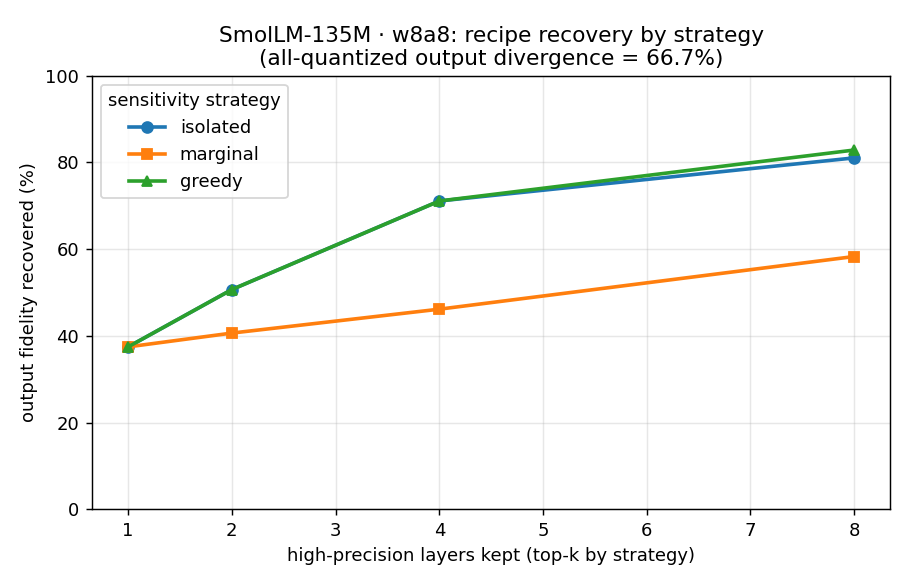
On SmolLM-135M / W8A8, quantizing all 30 layers moves the output 66.7%. All
three agree the single worst layer is layer.28 (the model’s massive-activation
layer) — keeping it alone recovers 37%. After that:
- marginal is the surprise loser — top-4 recovers only 46%. It measures each layer’s recovery in a context where everything else is still quantized, so it favors early layers whose recovery doesn’t transfer to a multi-layer recipe.
- isolated recovers 71% at top-4 — its intrinsic-difficulty ranking picks the late outlier layers that actually matter together.
- greedy is provably ≥ both and beats marginal clearly, but here it only ties isolated through k=4 and edges it at k=8 (82.8% vs 81.0%).
The interesting part is why greedy barely beats isolated: layer.28 dominates
so heavily that the interactions are weak, so the cheap filter (isolated)
lands on essentially the greedy-optimal set.
When interactions matter: int4 on a bigger model
Re-run on Qwen2.5-0.5B with int4 weight-only (a more aggressive scheme, on a model with no single dominating layer; all-quantized divergence 72.7%) and the picture changes — recovery (%) by strategy:
| keep k | isolated | marginal | greedy |
|---|---|---|---|
| 1 | 3.0 | 6.9 | 6.9 |
| 2 | 10.4 | 10.1 | 10.4 |
| 4 | 33.0 | 15.6 | 33.0 |
| 8 | 46.9 | 22.8 | 48.4 |
Now neither filter is robust: marginal wins at k=1 (no dominating layer, so
“what recovers most” beats “intrinsic difficulty”), but isolated wins by k=4.
greedy is the only strategy that’s best-or-tied at every k — it’s
effectively max(isolated, marginal) plus an edge at k=8. That’s the
wrapper-beats-filter payoff the feature-selection analogy predicts, and it only
shows up once interactions matter.
So the practical rule is the feature-selection rule: use a cheap filter when
one unit dominates; spend the wrapper (greedy) compute when sensitivity is
distributed. (Validated on real int4 kernels on GPU via
scripts/validate_quant_recipe_gpu.py.)
Granularity: layer vs Linear
The keep-or-quantize unit is also a knob (--granularity). By default it’s a
whole decoder layer (its 7 Linears together). At --granularity linear, each
nn.Linear is its own unit — finer recipes at ~7x the units (and ~7² the greedy
compute). On SmolLM-135M, going per-Linear sharpens the diagnosis: the most
quant-sensitive units are specifically the MLP projections of the late
layers (layer.28.mlp.up_proj tops it; attention barely registers). So you can
keep just a couple of Linears in fp rather than whole layers — cheaper for the
same recovery. (This is the same drill-down ladder as the parity tool’s
layer→head attribution; the floor for quant recipes is the Linear.)
Gate on a real eval: the accuracy bar
Everything above optimizes a surrogate — output divergence vs the fp baseline
on the calibration prompts. That ranks layers well, but it isn’t what you ship
against. The product question is: “give me the smallest recipe whose real
metric stays within X of fp on my eval set.” That’s --accuracy-bar:
firefly quant-recipe -m HuggingFaceTB/SmolLM-135M -i calib.json \
    --scheme w8a8 --accuracy-bar rel:0.05 \
    --eval eval.jsonl --metric perplexity
perplexity (↓ lower better)  fp baseline 41.42 → all-w8a8 47.01   (bar 5.0% rel → threshold 43.49)
┏━━━━━━━━━━━━━━┳━━━━━━━━━━━━┳━━━━━━━━━━━━━┓
┃ keep hi-prec ┃ perplexity ┃ within bar? ┃
┡━━━━━━━━━━━━━━╇━━━━━━━━━━━━╇━━━━━━━━━━━━━┩
│         0/30 │      47.01 │     no      │
│         1/30 │      43.86 │     no      │
│         2/30 │      43.45 │     yes     │   ← chosen
│         7/30 │      38.98 │     yes     │
│        15/30 │      38.62 │     yes     │
│        30/30 │      41.42 │     yes     │
└──────────────┴────────────┴─────────────┘
recipe: keep 2/30 layers in high precision → perplexity 43.45 (threshold 43.49).  kept: layer.28, layer.29
7 real evals spent (binary search + baseline + floor).
The win is the two-tier metric. The cheap proxy ranks all 30 layers (one
forward each — the filter); the expensive real eval is spent only to gate
candidate recipes, and a binary search over the ranking finds the smallest
passing keep-set in ~log₂(N) evals (the wrapper). Here it kept just the two
late massive-activation layers (layer.28, layer.29) in fp and quantized the
other 28 — at the cost of 7 evals, not 30.
The metric is pluggable: --metric perplexity (built-in) or a
module:function callable taking (model, tokenizer) → float (carry a
higher_is_better = False attribute for a loss-style metric). The bar is
rel:<frac> (within X% of baseline) or abs:<delta> (absolute metric units),
and the direction is handled for you — a floor below baseline for accuracy, a
ceiling above it for perplexity.
One honesty note visible in the table above: the recovery curve is not strictly monotonic — keeping 15 layers fp (perplexity 38.62) actually beats full fp (41.42) on this tiny eval, because partial quantization can act as mild regularization. The binary search assumes monotonicity to stay cheap, so it returns the smallest confirmed-passing recipe rather than a proof of global minimality; for a CI gate that’s the right trade. (This is the verification substrate the planned agent-in-the-loop “agentic quantization” sits on top of: every proposed intervention is gated by a real, cheap-to-verify eval.)
Cost, and the Pareto frontier
A recipe has two numbers that matter, and they trade off: quality (perplexity / divergence) and cost (weight memory). Keeping more layers in fp buys quality but costs bytes; quantizing more is cheaper but worse. So Firefly attaches an exact memory cost to every recipe — the quantizable Linears at their actual precision (base dtype for kept units, scheme bits for the rest; int4wo’s group scales included) — and reports the trade-off, not a single number.
The organizing idea is domination: recipe A dominates B if A is no worse on
both size and quality and strictly better on one — nobody rational picks B. The
Pareto frontier is the set nobody dominates, and it’s where the accuracy-bar
table earns the Pareto column:
perplexity (↓ lower better)  fp baseline 41.42 → all-w8a8 47.01   (bar 5.0% rel → threshold 43.49)
weight footprint: all-fp 424.7 MB → all-w8a8 106.2 MB (4.0× smaller)
┏━━━━━━━━━━━━━━┳━━━━━━━━━━━━┳━━━━━━━━━━┳━━━━━━━━━━━━━┳━━━━━━━━━━┓
┃ keep hi-prec ┃ perplexity ┃   memory ┃ within bar? ┃  Pareto  ┃
┡━━━━━━━━━━━━━━╇━━━━━━━━━━━━╇━━━━━━━━━━╇━━━━━━━━━━━━━╇━━━━━━━━━━┩
│         0/30 │      47.01 │ 106.2 MB │     no      │ frontier │
│         2/30 │      43.45 │ 127.4 MB │     yes     │ frontier │   ← chosen (cheapest in-bar)
│         3/30 │      40.58 │ 138.0 MB │     yes     │   knee   │
│        15/30 │      38.62 │ 265.4 MB │     yes     │ frontier │
│        30/30 │      41.42 │ 424.7 MB │     yes     │          │   ← DOMINATED
└──────────────┴────────────┴──────────┴─────────────┴──────────┘
The headline is the last row: full fp (30/30) is not on the frontier. Keeping 15 layers gives lower perplexity (38.62 vs 41.42) at less memory (265 vs 425 MB) — partial quantization acted as mild regularization here, so shipping the full fp model would be strictly wasteful. A recovery curve indexed by k can’t show that; the frontier, indexed by actual cost, drops it automatically.
Three ways to read a point off the frontier:
- the accuracy bar picks the cheapest recipe that clears your quality threshold (here: keep 2 layers, 3.3× smaller than fp);
- the knee (
kneerow) is the best quality-per-byte before diminishing returns — the natural default when you don’t have a hard bar; - anything not marked is dominated — never the right choice.
Budgeting the search
The expensive part is the measurements (a deepcopy + quantize + forward each), and
the count is known a priori from #units × strategy × k — so --max-measurements
caps it before anything runs:
$ firefly quant-recipe ... --strategy greedy --granularity linear --max-measurements 50
estimated 1653 measurements (over 210 units) exceeds --max-measurements 50.
Use a coarser --granularity, fewer --k-values, or raise --max-measurements.
That guard is what stops an accidental O(N·k) greedy-on-Linears run (1653 forwards here) from starting unannounced on a real model.
Beyond keep-fp: interventions (SmoothQuant)
Mixed precision is the coarse lever — keep a whole layer in fp. But many quant
failures have a targeted fix that doesn’t cost any fp layers. The most common
is activation outliers: a few input-channel activations are huge, so per-token
int8 activation quant sets its scale from them and crushes every other channel.
The right treatment isn’t “keep the layer fp” — it’s SmoothQuant, which uses
the identity Y = X·Wᵀ = (X/s)·(s·W)ᵀ to migrate the outlier magnitude from the
activations into the weights (which quantize fine). Same output, both tensors now
easy to quantize.
Firefly applies it as a pre-transform in front of the quantizer (--smoothquant),
calibrated on --inputs:
firefly quant-recipe -m HuggingFaceTB/SmolLM-135M -i calib.json \
    --scheme w8a8 --smoothquant ...
On SmolLM-135M / w8a8 the effect is dramatic — and reproduces on CPU:
| output divergence vs fp | |
|---|---|
| plain w8a8 (all layers) | 66.7% |
| w8a8 + SmoothQuant | 8.5% |
An 87% recovery with zero fp layers kept — a different axis from mixed
precision, and they compose (smooth first, then keep the few layers SmoothQuant
can’t rescue). This is the first technique to plug into Firefly’s intervention
seam: a stable apply(model, policy, calib) → model' interface where each
technique is a thin adapter, ordered by stage (pre-transforms, then the
quantizer). SmoothQuant’s core is simple enough to own (~50 lines of per-channel
rescale); GPTQ/AWQ will be wrapped from their libraries against the same
interface. The attribution decides which failure mode you have; the seam lets
the matching treatment slot in.
Diagnosis: connecting the measurement to the treatment
The seam (above) is the actuator; the missing half was the sensor — something
that reads the measurements and says which failure mode this model has.
firefly quant-diagnose is that sensor. It runs on the stored activations (no
model run) and emits a measured, causal diagnosis routed to the intervention
that treats it:
$ firefly quant-diagnose -r reference/
Firefly quant diagnosis — 3 finding(s)
  activation_outliers @ layer.29.mlp → smoothquant
    layer.29.mlp: int8 per-tensor error 34% is dominated by outlier channels (70x
    concentration) — per-channel rescues it to 0.4% (84x). SmoothQuant migrates those
    outliers into the weights so per-token activation quant stops crushing the rest;
    apply --smoothquant and verify against an --accuracy-bar.
verify: firefly quant-recipe -m <model> -i <inputs> --smoothquant --accuracy-bar rel:0.01 ...
That explanation is the thing autoquant can’t give: not “your eval dropped,” but
“this layer’s int8 error is a few outlier channels, here’s the technique that
moves them, go verify it.” The loop is diagnose → route → optimize_to_bar
verifies → explain from the measured before/after — deterministic and fully
measured (no LLM).
Honest coverage — this is the important part. quant-diagnose only emits
signatures it can actually detect from the activation-capture substrate:
- activation-outliers (→ SmoothQuant) — from quant-risk’s
channel_concentration. - single-unit-dominance (→ mixed precision) — from a sensitivity sweep where one unit’s quant sensitivity dwarfs the rest.
It deliberately does not ship labels for failure modes it can’t measure. AWQ
now has both halves: a sensor (firefly quant-salience measures mean|X|·max|W|
per input channel, surfacing the same outlier-feature down_projs the activation
tools flag) and a treatment (AWQQuantizer, wrapping torchao’s AWQ as a
QUANTIZER intervention). On Qwen2.5-7B that treatment recovers ~91% of the
int4 perplexity gap — exactly the distributed int4 damage the mixed-precision
recipe could only recover ~9% of, confirming the diagnosis (int4 → AWQ territory,
not keep-fp). GPTQ’s case is the one that stays out: it’s justified in
weight-space (the Hessian), which a forward pass can’t observe. A general “agent picks the next
technique” loop runs into a second wall too — the technique axis isn’t monotone
(SmoothQuant changes AWQ’s salience, can help or hurt GPTQ), so the cheap
keep-set binary search doesn’t transfer; each technique combination is a full
re-quant + re-eval. So Firefly’s quant agent is, honestly, a diagnosis-routed
recipe selector for the failure modes it can detect — the search only tunes the
(monotone) keep-set inside the chosen template. That’s the half that’s both
viable and differentiated; the autonomous technique-search agent is not claimed.
Firefly as an oracle: the agent step primitive
The honest shape of “agentic quantization” isn’t Firefly ships an agent — it’s
Firefly is the measurement oracle + a closed action contract, and an external
coding agent is the searcher. The agent reads the raw measurements
(quant-diff / quant-sensitivity / quant-diagnose JSON), proposes a policy,
and calls one step primitive that applies + verifies + attributes it:
firefly quant-step --policy policy.json --reference ref/ --inputs calib.json \
    --eval eval.jsonl --bar rel:0.01 --baseline-metric 7.9 --report-json step.json
policy.json is just a Recipe (the same artifact --export produces) —
deserialized through the intervention registry, so the agent can only compose
validated interventions, never run arbitrary code. That’s the sandbox, for
free. The step returns one JSON with everything needed to choose the next move:
{ "passed": true,
  "metric": {"name":"perplexity","value":41.2,"baseline":41.4,"threshold":43.5},
  "cost":   {"bytes":127401984, "compression":3.33},
  "attribution": {"first_divergent_tap":"layer.0.self_attn",
                  "worst_taps":[{"tap":"layer.3.self_attn","rel_mean":0.12}, ...]} }
The differentiator is the attribution field: not just pass/fail, but where
the quantized run still drifts from fp — a map for the next proposal, the thing
autoquant’s scalar score can’t give. The fp baseline is paid once: the per-tap
attribution diffs against the stored reference/ (no fp re-run), and the fp eval
metric is threaded back via --baseline-metric so the loop computes it a single
time.
Scope, honestly: this is the oracle + contract, not an agent. The loop driver (which LLM, which prompt) is a thin, disposable harness the user supplies; Firefly owns the measurement and the structured action space. And it earns its keep in the under-explored-architecture regime (custom / recsys-shaped models with no known recipe), not on Llama-family models where the recipe is known and torchao’s faster search already wins.
Putting it together: deterministic auto-quant
firefly quant-auto ties the whole loop into one pass — the agent-agnostic
harness with a deterministic proposer (the router; an LLM plugs into the same
diagnosis → recipe slot later). It diagnoses the model, routes each signature
to the intervention that treats it, applies the routed recipe and a plain-quant
baseline, and — crucially — verifies: it ships the routed recipe only if the
measurement says it actually helped.
$ firefly quant-auto -m Qwen/Qwen2.5-7B-Instruct -i calib.json --eval eval.jsonl --scheme int4wo
diagnosis: activation_outliers ×N, salient_weight_channels ×M
routed recipe: AWQ quantizer (salient_weight_channels)
verified: perplexity fp 11.69 → plain int4wo 17.31 → routed 12.20
ACCEPTED — routed recipe recovers 91% of the degradation; ship it.
residual divergence concentrated at: layer.24.mlp (72%), layer.23.mlp (70%), ...
That’s the honest win: given only Firefly’s measurements (no human picked the technique), the agent autonomously diagnosed the failure mode, routed to AWQ, verified a 91% recovery, and explained why — on the exact 7B int4 case where the mixed-precision recipe recovered only ~9%. Every step is measured and sandboxed (the action is a structured recipe, not code).
The verify step is the differentiator, and it cuts both ways. On SmolLM-135M w8a8 the router proposes SmoothQuant, but verification rejects it (perplexity 47.01 → 53.77 — SmoothQuant’s benefit grows with scale and doesn’t generalize at 135M) and ships plain. The router proposes by signature; the measurement is ground truth. That’s what an LLM proposer will sit on top of — every proposal cheaply verified, which is the thing blind autoquant and ungrounded agents lack.
Reproduce it
# the comparison plot above (CPU, ~20s):
uv run python scripts/demo_quant_recipe.py

# rank layers by sensitivity:
firefly quant-sensitivity -m HuggingFaceTB/SmolLM-135M -i golden.json --scheme w8a8

# build + verify a recipe (try --strategy isolated | marginal | greedy):
firefly quant-recipe -m HuggingFaceTB/SmolLM-135M -i golden.json \
    --scheme w8a8 --strategy greedy --k-values 1,2,4,8

# or gate on a real eval metric instead of the divergence proxy:
firefly quant-recipe -m HuggingFaceTB/SmolLM-135M -i golden.json \
    --scheme w8a8 --accuracy-bar rel:0.05 --eval eval.jsonl --metric perplexity
--scheme int4wo runs the same thing for int4 weight-only (needs a CUDA GPU).